
Smart homes have been a buzzword in real estate for years, but most projects still treat “smart” as a marketing sticker rather than something built into the bones of the home. JOUD Residence on Al Reem Island takes a different approach, with AI-enabled home systems built into the structure itself rather than added on as an afterthought. Here’s a closer look at what that actually means day to day.
Not Just Gadgets — A System Built Around You
The easiest way to think about this is the difference between a home full of smart devices and a home that’s actually smart.
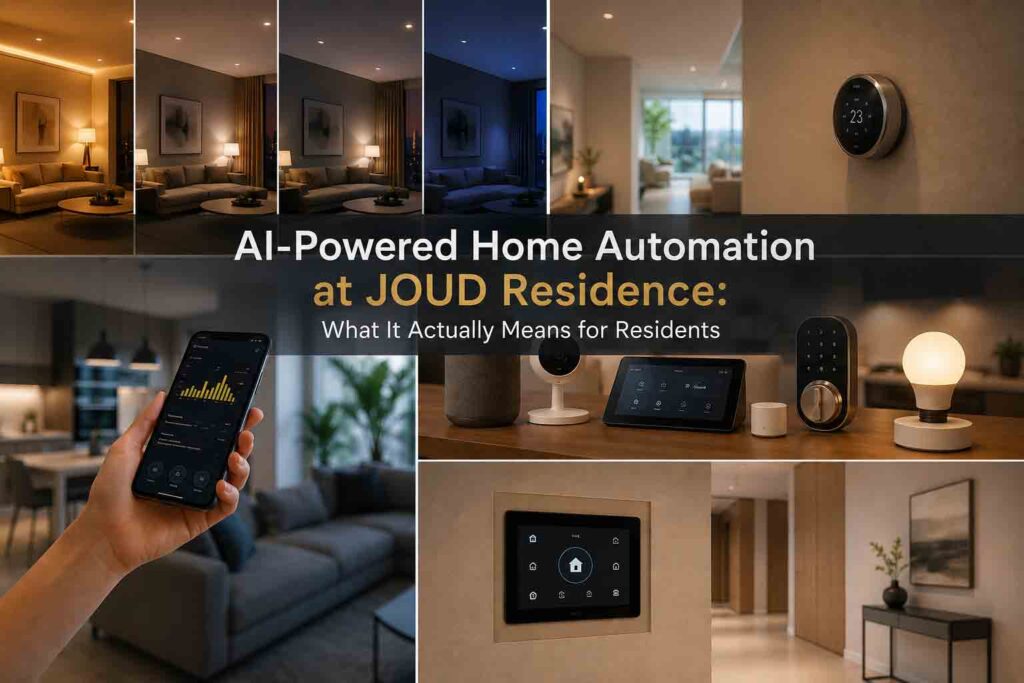
Plenty of buildings offer a smart thermostat here, a voice assistant there, and call it a smart home. At JOUD Residence, the concept is positioned differently: an AI-powered system designed to connect core residential functions such as lighting, climate, security, and other home controls through a unified experience.
That single-interface approach matters more than it sounds.
Instead of managing multiple devices through separate applications, residents can have a central control point for key home functions.
What the System Actually Does
Based on the project’s stated smart-living concept, the home automation setup focuses on several core areas.
Smart Lighting
Smart lighting can make everyday routines more convenient by allowing residents to control lights digitally and create automated settings.
More advanced systems can potentially use occupancy, schedules, and user preferences to adjust lighting automatically.
The objective is simple: reduce the amount of manual control required during everyday routines.
Climate Control That Thinks Ahead
Air conditioning is particularly important in Abu Dhabi’s climate.
An AI-driven system can potentially adjust temperature settings according to factors such as time of day, occupancy, and resident preferences.
Instead of relying entirely on fixed settings, intelligent climate management aims to maintain comfort while avoiding unnecessary cooling.
For buyers researching the development, the JOUD Residence project provides more information about its smart-home concept and residential features.
Energy Optimization
One of the potentially practical advantages of connected home automation is energy management.
When lighting, cooling, and other systems are coordinated, residents may be able to reduce unnecessary consumption.
However, actual savings depend on how the system is configured, how residents use their homes, the building’s infrastructure, and prevailing utility costs.
Therefore, buyers should view energy efficiency as a potential benefit rather than a guaranteed reduction in electricity bills.
Connected Devices Working Together
A smart light, smart lock, and smart thermostat operating independently are still separate devices.
A more integrated system allows different components to communicate with each other.
For example, leaving the apartment could potentially trigger a coordinated sequence involving:
- Lighting
- Air conditioning
- Security
- Access control
- Other connected devices
This is where integrated automation can provide a more seamless experience than a collection of standalone smart gadgets.
A Clean Digital Interface
The project’s smart-home concept also focuses on keeping technology visually integrated into the interior.
A centralized control interface can provide access to home-management functions without requiring residents to fill the apartment with separate screens, switches, and connected devices.
The principle is straightforward:
Technology should support the home rather than dominate it.
Why This Matters Beyond Convenience
It is easy to classify AI home automation as a luxury feature.
However, there are several practical reasons integrated technology can become increasingly relevant in modern residential developments.
Less Daily Mental Load
Automation can remove small repetitive tasks from everyday life.
Instead of manually checking whether the AC is running or adjusting multiple lights, residents can use predefined routines or automated settings.
These small conveniences can make a noticeable difference over time.
Potentially Lower Running Costs
Intelligent energy management may help reduce unnecessary electricity consumption when lighting and cooling are adjusted according to actual usage.
The potential benefit is particularly relevant in Abu Dhabi, where air conditioning represents an important part of residential energy consumption.
However, actual savings should be evaluated using the building’s specifications and real-world operating data once available.
Built-In Future Readiness
A home designed around connected technology from the beginning can have an advantage over older apartments that require individual smart devices to be installed later.
This can make it easier to introduce additional connected devices and automation as technology develops.
Potential Appeal to Renters and Future Buyers
Smart-home technology can be attractive to technology-focused residents and buyers.
However, it is important not to assume that AI automation automatically guarantees higher rent or resale value.
The technology is one factor among many, including:
- Location
- Property size
- View
- Building quality
- Amenities
- Service charges
- Rental demand
- Overall market conditions
For JOUD Residence on Al Reem Island, the smart-home positioning is therefore best considered as one part of the project’s overall investment proposition rather than a guaranteed financial premium.
A Few Honest Things to Keep in Mind
As with any emerging building technology, buyers should approach AI-powered home automation with realistic expectations.
“AI-Powered” Can Mean Different Things
The term AI-powered can describe very different levels of technology.
Ask specifically:
- What functions are genuinely automated?
- Which functions require manual input?
- Does the system learn resident preferences?
- Does it use occupancy or environmental data?
- Which devices are integrated?
- Can residents control everything from one platform?
There is a major difference between an AI system that actively automates the home and a collection of devices that can simply be controlled through an app.
Maintenance and Support Matter
A smart-home system is only as useful as the support behind it.
Before purchasing, buyers should ask:
- Who maintains the system after handover?
- What happens if a sensor stops working?
- Who replaces faulty hardware?
- Are software updates included?
- Is there an ongoing subscription?
- Who provides technical support?
These details can matter just as much as the technology itself.
Data and Privacy Questions Are Fair to Ask
Connected homes can process information related to occupancy, preferences, device usage, and other aspects of daily life.
Buyers should therefore ask the developer or technology provider:
- What data is collected?
- Where is it stored?
- Who can access it?
- How is it protected?
- How long is it retained?
Understanding these policies is particularly important when technology becomes deeply integrated into everyday living.
The Building Is Still Under Construction
This is perhaps the most important consideration for an off-plan buyer.
Marketing materials describe the intended product, but the actual experience can only be fully evaluated once the building is completed and operating.
For this reason, buyers should confirm the final technology specifications, technology provider, equipment included, maintenance arrangements, and warranty terms directly with the developer before signing.
The Bigger Picture
Smart-home technology is becoming increasingly common in new residential developments.
Features such as intelligent lighting, automated climate control, connected security, and centralized digital interfaces are moving from luxury extras toward expected features in newer technology-focused buildings.
The important question is therefore no longer simply:
“Does this apartment have smart-home technology?”
The better question is:
“How deeply is the technology integrated into the building and everyday living experience?”
For buyers considering JOUD Residence, the AI-powered automation concept is one of the project’s key differentiating features on paper.
The potential benefits include greater convenience, personalized control, integrated home management, and potentially more efficient use of energy.
But buyers should distinguish between promised features and proven performance.
As with any pre-construction property, the safest approach is to confirm the final specifications directly with the developer and, where possible, understand the actual technology partner, maintenance arrangements, warranty, privacy policy, and post-handover support before making a final investment decision.
Comments