
“Smart home” has become one of the most overused phrases in UAE real estate marketing. Nearly every new launch across Dubai and Abu Dhabi now advertises it, which makes the term almost meaningless on its own. The more useful question for a buyer isn’t does this building have smart home features — it’s which tier of smart home does it actually offer, and does the automation reach the whole building or just your unit’s app.
This piece breaks down what’s now considered baseline across UAE developments, what’s still a genuine differentiator, and how JOUD Residence on Al Reem Island built around an AI-integrated living concept from the ground up — fits into that picture.
Tier 1: What’s Now Standard — Not a Differentiator Anymore
If a development markets itself as a smart home in 2026, several features are close to a given rather than a major bonus:
- App-controlled lighting and air conditioning
- Smart door locks and remote or keyless entry
- Basic CCTV with mobile monitoring
- Voice assistant compatibility such as Alexa and Google Home
Multiple newer developments in Al Reem Island already offer similar technology alongside amenities such as EV charging and 24/7 security.
In Dubai, the shift is even further along. Major developers increasingly include smart-home technology in new residential projects as a core feature rather than an optional upgrade.
In short, if this is the extent of the “smart” pitch, it is becoming table stakes rather than a compelling reason to choose one tower over another.
Tier 2: What Actually Differentiates a Building
The real gap between developments appears at the next level, where automation moves beyond unit-level convenience and becomes a genuinely integrated system.
AI-Driven Prediction, Not Just Remote Control
There is a significant difference between:
“I can turn the AC on from my phone.”
and:
“The system can automatically adjust the apartment based on my preferences and usage patterns.”
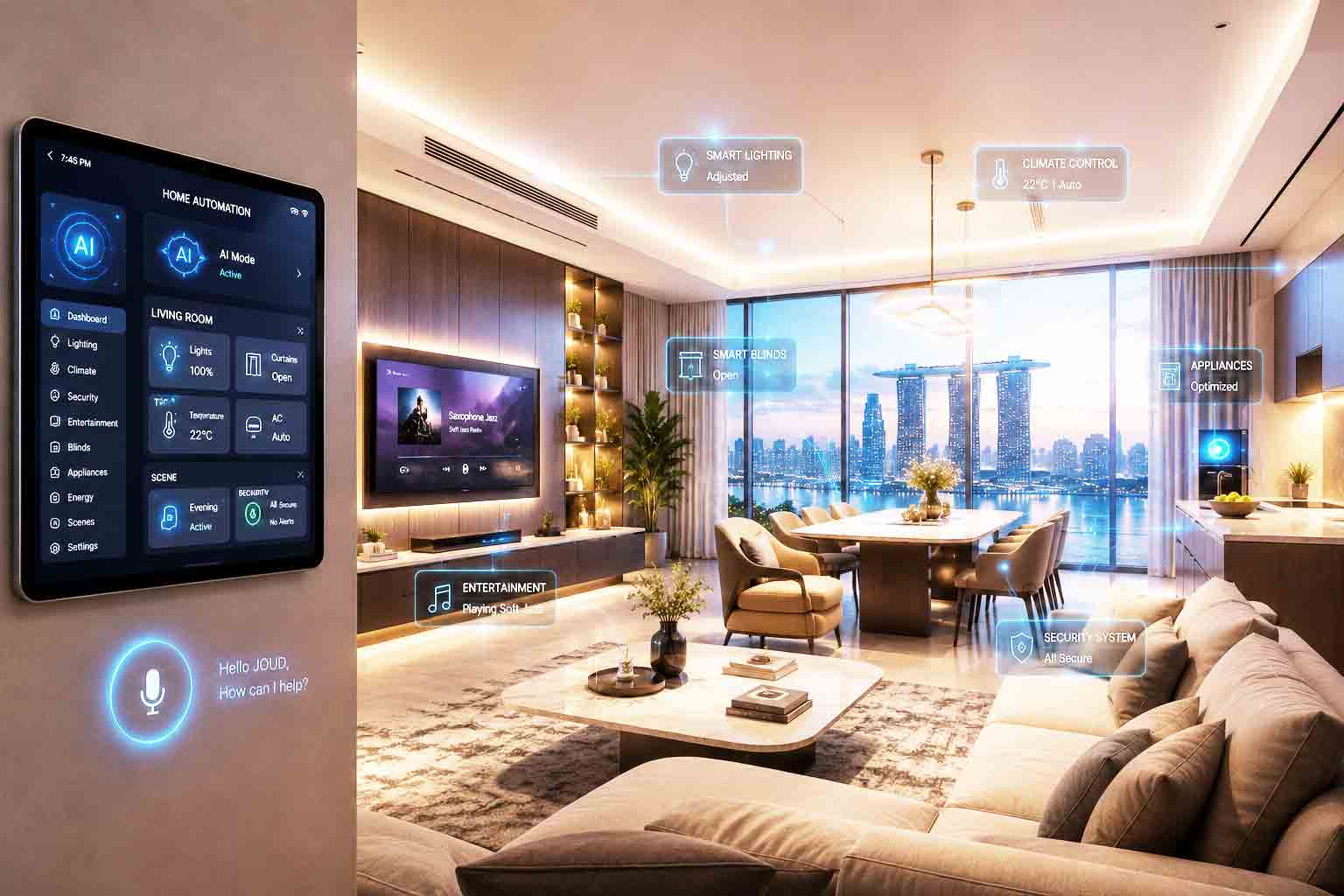
AI-powered home systems can potentially automate HVAC, lighting, entertainment, and other functions based on user behaviour instead of requiring manual input every time.
This is where the term AI-integrated living becomes more meaningful than simply calling an apartment a smart home.
Building-Wide IoT, Not Isolated Devices
A smart lock and smart thermostat that do not communicate with each other are essentially two separate connected devices.
A more advanced system connects multiple devices through a centralized platform, allowing security, climate control, lighting, access, and other systems to work together.
For buyers considering new residential developments on Al Reem Island, this distinction is worth investigating before comparing projects.
Wellness and Environment-Aware Automation
Modern smart developments are also moving beyond basic convenience.
Examples can include:
- Circadian lighting
- Indoor air-quality monitoring
- Automated temperature management
- Environmental sensors
- Personalized lighting settings
- Smart wellness systems
These technologies shift smart-home automation from simple convenience toward health, comfort, and lifestyle management.
Software That Runs the Building, Not Just the Unit
The most advanced concept goes beyond the individual apartment.
Building-wide technology can potentially connect:
- Elevators
- Security systems
- Parking
- Common-area lighting
- Energy management
- Access control
- Climate systems
- Resident services
Abu Dhabi’s Masdar City provides a useful example of how connected technology and smart infrastructure can operate at a wider district level.
The important distinction is that smart technology can be designed into the infrastructure itself rather than simply adding connected gadgets inside individual apartments.
Neutral, Future-Proof Platforms
Buyers should also investigate what happens after handover.
A building may advertise an impressive smart-home system, but buyers should ask:
- Who provides technical support?
- Are software updates included?
- Is there an ongoing subscription?
- Can devices from other manufacturers be integrated?
- What happens if the original technology provider changes?
- Will the system remain useful several years after handover?
A more flexible platform can potentially make a property easier to maintain and more attractive to future buyers.
Quick Comparison
| Feature | Typical “Smart-Enabled” Tower | AI-Integrated Tower |
|---|---|---|
| Lighting & AC | App-based manual control | Learns patterns and can adjust automatically |
| Security | Smart locks + basic CCTV | Integrated access, CCTV and monitoring |
| Devices | Individually controlled | Unified ecosystem |
| Energy | Smart meter and usage visibility | Usage optimisation based on patterns |
| Scope | Primarily unit-level | Unit and potentially building-wide systems |
| Personalisation | Manual settings | Automated preferences and routines |
| Wellness | Limited | Potentially integrated environmental monitoring |
Where This Leaves JOUD Residence
JOUD Residence is positioned toward the AI-integrated end of this spectrum rather than simply offering the baseline smart-home features increasingly found in new developments.
Located on Al Reem Island, the project combines smart-living technology with a waterfront residential setting and modern amenities.
The important point for buyers is not simply whether a project uses the word “AI.”
The more useful question is what the technology actually does.
If AI only appears in marketing language while residents still manually control every system, the difference from a conventional smart home may be limited.
If the technology genuinely connects multiple systems, learns preferences, improves energy efficiency, supports security, and enhances everyday living, then it becomes a more meaningful differentiator.
For the most accurate information, buyers should review the official JOUD Residence features and amenities rather than relying only on third-party descriptions.
What to Actually Ask When Comparing Buildings
For buyers evaluating any Al Reem Island property or wider UAE development marketed as a “smart home,” these are the questions that matter:
1. Is the automation unit-level only?
Ask whether the technology extends beyond the apartment to common areas, security, access control, parking, elevators, and other building systems.
2. Does the system learn and predict?
There is a major difference between manually controlling devices through an app and having the system automatically respond to established preferences and patterns.
3. Is the platform open or proprietary?
Ask whether the system works with established smart-home ecosystems or depends entirely on a proprietary platform.
4. What happens after handover?
Find out who provides technical support, software updates, maintenance, and replacement services after residents move in.
5. Does the building have sustainability credentials?
Smart technology should not only be about convenience.
Ask whether the development also incorporates energy efficiency, environmental monitoring, sustainable materials, or recognized sustainability standards.
The Bottom Line
The phrase “smart home” is becoming less meaningful on its own.
In 2026, app-controlled lighting, smart locks, remote AC control, and basic connected security are increasingly common in new developments.
The real differentiator is what happens beyond those basic features.
A genuinely advanced residential development should ideally connect multiple systems, automate repetitive tasks, improve comfort, support security, and potentially use data and AI to make the living experience more responsive.
For buyers comparing JOUD Residence with other developments on Al Reem Island, the key is therefore not to ask:
“Is this a smart home?”
Instead, ask:
“How smart is the building, what does the technology actually do, and what will still work after handover?”
That distinction can help separate genuine technological differentiation from standard features packaged as a premium selling point.
Comments